Legal News Update: Parliamentary panel flags gap between curriculum design and textbook availability for classes 9-12
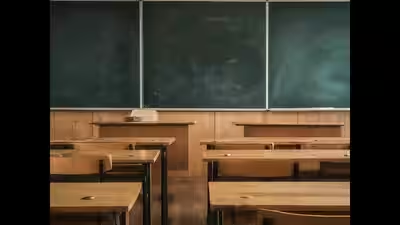
A parliamentary committee has highlighted the gap in the design and implementation of the curriculum of Classes 9 to 12, noting that the lack of textbooks has put additional burden on the children taking board exams due to the delay in the supply of new textbooks. It was found that although the Central Board of Secondary Education (CBSE) had made changes to its curriculum in line with the objectives of the NEP 2020 and the NCF 2023, the NCERT had not finalized the textbooks accordingly.The above-mentioned points constitute the contents of the Tenth Report of the Committee on Estimates (2026-27) tabled in Lok Sabha this week after conducting a review of the aspects of school education in the budget and policy matters of CBSE. It was found that this inconsistency in designing and implementing the curriculum has forced the schools to teach the applied level of curriculum using old study materials, creating difficulties for those students who will be writing the board exams of Class 10 and 12.
Textbook delays and teacher training
The panel has asked the Ministry of Education to speed up the printing and distribution of pending textbooks and to ensure closer coordination between NCERT and CBSE. It also recommended a nationwide programme to train teachers in application-based teaching methods.On existing training efforts, the committee acknowledged that CBSE has trained over 11 million participants in the last five years, offering free sessions to government school teachers. However, it raised concerns over a steep fall in online training numbers — from 5.3 million teachers in 2022 to just around 1,62,814 in 2025. It also flagged that private school teachers, especially in rural areas, must pay extra fees for training that government school teachers receive for free.
Enrolment, fees, and transparency
The report noted a rise in exam registrations, with Class 10 enrolment growing from 22,51,812 in 2024 to 23,85,079 in 2025, and Class 12 numbers rising similarly. While visually impaired students are exempt from the Rs 1,600 examination fee, the panel said CBSE offers no fee relief for economically weaker students and recommended introducing targeted waivers. It also called for more transparency in answer-sheet evaluation and continuous upgrades to CBSE’s digital exam infrastructure, Pariksha Sangam.
The bigger picture on education spending
The committee highlighted that combined education spending by the Centre and states stands at 4.1% of GDP, well short of the NEP’s 6% target. Although the Union Budget 2026-27 raised the Ministry of Education’s allocation to Rs 1,39,286 crore, the panel pushed for a mandatory 10% annual increase in education spending and a dedicated, non-lapsable fund to support long-term reforms.
Stay updated with the latest legal news, judgments, internships, and opportunities.
CBSE curriculum changes,NCERT textbooks,board exams,Parliamentary panel,curriculum design,NEP 2020,textbook availability,education spending,teacher training,economically weaker students