Legal News Update: Govt to tighten vehicle lighting rules: Low-beam-only bikes, reduced headlamp glare
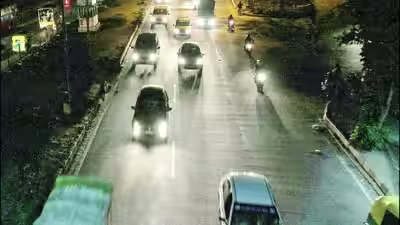
NEW DELHI: Automatic headlamps in two-wheelers will soon work only in passing beam (low beam) mode, and buses and other heavy vehicles will have to use genuine reflective tapes to improve visibility at night and in bad weather. Also, the use of high-intensity headlamps will be restricted across all categories of vehicles to curb glare, which causes visual discomfort or impairs the vision of other road users.The road transport ministry has proposed these changes, among others, through draft amendments to Central Motor Vehicles Rules, with the new safety norms set to take effect from next April. The amendments in automotive vehicle standards are being made given that efforts to persuade drivers and make them aware of the need to use low-beam mode have not yielded desired results.The automatic headlamp norms would be applicable only for new two-wheelers and not existing ones. At present, the Automatic Headlamp On (AHO) system can switch on both low beam and high beam modes depending on vehicle settings. The proposed rule mandates that when the automatic system is active, the headlamp will be on low beam.As for high-intensity headlamps, the maximum permissible intensity has been reduced from 1.5 lakh candela or cd (official base unit of luminous intensity) to 1 lakh cd for two-wheelers. The maximum permissible intensity for 4-wheelers (cars) has been reduced from 2.25 lakh cd to 1.5 lakh cd.As per studies, white light emitted from headlamps and front fog lamps with higher colour temperatures cause significant glare, leading to discomfort and reduced visibility for other road users. To address this issue, the maximum permissible colour temperature has been restricted to 6,500 Kelvin (K).It has also been proposed that the mounting height of main-beam headlamps be equivalent to that prescribed for passing-beam headlamps.These measures target one of the major causes of night-time road crashes in India — drivers using headlamps on high beam in urban areas, which can temporarily blind motorists approaching from the opposite direction, reducing visibility and increasing the risk of crashes.TOI has learnt that the new-generation system will also include an audio alert to discourage unnecessary use of high-beam mode on city roads. If a driver manually switches to high beam in urban conditions, the vehicle will prompt them to shift back to low beam.However, the alert will be speed sensitive. Drivers travelling on highways at speeds above 60 kmph won’t receive the warning, since the use of high-beam mode may be necessary on poorly illuminated highway stretches. The feature is intended to promote safer driving behaviour in urban areas while ensuring that highway driving is not adversely affected, officials said.The draft amendments also revise lighting requirements across vehicle categories. Besides restricting use of automatic headlamps to low-beam mode, they update norms for high-end headlamps with adaptive passing beam and adaptive high beam.
Stay updated with the latest legal news, judgments, internships, and opportunities.
vehicle lighting rules,automatic headlamps,night-time road crashes,low-beam motorcycle,high-intensity headlamps