Legal News Update: Everything announced at ‘Made by Google 2026’: Pixel 11 phones, Pixel Watch 5, and a lot more AI
Made by Google events have become more of a show. Jimmy Fallon hosted the last one, and now Trevor Noah is taking over, with Stephen Curry, Alex Cooper and Peggy Gou filling out the evening, which is not a guest list anybody assembles with spec sheets in mind. And while the show is still to begin, the phones and everything else are already out, hours ahead of the stream, so there’s nothing left for it to reveal. It’s a celebration, put on for an audience that isn’t the one arguing about these phones for the next six months. The funny part is that this year, the hardware is almost entirely for them.Nearly everything Google has announced answers a complaint somebody has been making for years. Night Sight took too long. The Fold never quite shut. The more affordable Pixel ran short on memory.One of them has been outstanding since 2017. Google has put a ring of LEDs around the camera flash on the Pixel 11 Pro and called it HiLight. Every Nexus had one. The Pixel 2 had the last, and then always-on displays arrived and Google stopped bothering. Nine years on, it’s back, pointed at the wrong side of the phone on purpose.Elsewhere: a faster Night Sight, a Fold that shuts flush, and 12GB of RAM on the cheapest Pixel. And where there wasn’t a complaint to answer, Google added AI.So no single big idea holds this lineup together, and that’s fine. Years of small fixes and a lot of AI are what tie this year’s line-up together. And while you wait for the show to begin, here’s a rundown of everything Google announced, so you can just eat the popcorn and enjoy the hour.
The Pixel 11 and the Pro are further apart than they’ve ever been
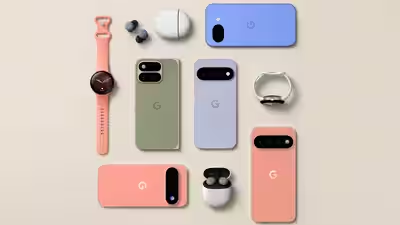
The two Pixels have less in common this year than they have in a while, though you wouldn’t know it from the outside.The familiar camera bar keeps its shape, with the glass now running edge to edge into the frame rather than sitting on top, slimmest of all on the Pixel 11. The Pixel 11 got the cheerful colours and the Pro got the serious ones. Frost, Hibiscus, Pistachio and Obsidian on one side. Canyon, Olive, Fog and Matte Obsidian on the other, and that matte black is the first Google has offered on a Pro model.The Pixel 11 gets a 3,000-nit Actua panel behind Gorilla Glass Victus 2. The Pro pair gets Super Actua at 3,600 nits, which Google puts at 9 per cent brighter than last year and more than twice as scratch resistant, and is calling the toughest display it has shipped. Under the Pro models sits a vapour chamber to keep the chip from throttling during long camera sessions. All three are IP68.The cameras split the same way. A 48MP main on the Pixel 11, a 50MP main and a rebuilt telephoto on the Pro pair, and a gap in reach between the two that has never been wider. More on that below.Memory is the more consequential split, and it comes with a catch. The Pixel 11 starts at 256GB with 12GB of RAM, the highest floor a base Pixel has had. That isn’t generosity. Gemini Intelligence won’t run on less, so the floor had to move. The Pro pair climbs to 16GB and 512GB.Charging won’t sell anybody a phone. It’s still the upgrade you’ll notice most often. All three clear 30 hours on Adaptive Battery, and half an hour on a cable takes the Pro XL to 75 per cent and the other two to 55. A new Extreme Charging Mode redirects the phone’s whole performance budget into the battery for when you’re in a rush.Pixelsnap magnets are built into the phones now instead of the case, worth up to 29 per cent faster wireless charging on the Pixel 11 Pro, 25 on the Pixel 11 and 17 on the Pro XL. A Clear Case, a silicone case and a Ring Stand go with them.The Pixel 11 is Rs 89,999, the Pixel 11 Pro is Rs 1,19,999 and the Pro XL is Rs 1,34,999. Buy either Pro and six months of Google AI Pro comes with it, which Google values at Rs 11,700.
The Pixel 11 Pro Fold finally shuts flat
The camera housing on the Fold is now a dual pill instead of a block, and Google was oddly upfront about why. It was the thing stopping the phone from closing flush.That fix sits alongside a millimetre off the thickness, roughly a tenth off the weight, a new hinge, a soft-touch composite back, an IP68 rating, and a body Google’s own testing puts at three times stronger than last year’s.Both screens gain 20 per cent in brightness, and the outer one moves to Super Actua for the first time, which should matter more than the spec suggests given how much foldable time goes to the cover screen. Inside is an 8-inch Super Actua Flex panel.The camera is a 48MP main drawing 56 per cent more light than the Pixel 10 Pro Fold’s, with a telephoto and 30x Super Zoom. Three features make use of the hinge itself. Made You Look plays animations on the outer screen while you frame, aimed at anyone who has tried to photograph a four-year-old. Dual Screen Preview lets your subject watch themselves pose. Rear Camera Selfie has you unfold the phone, frame yourself on the cover display and shoot with the main sensor rather than a front camera.Multitasking gets Split Screen, floating app Bubbles capped at five, drag and drop between apps, and a tabletop mode. There’s 16GB of RAM, over 24 hours of battery and 50 per cent charge in half an hour. It costs Rs 1,86,999 with 512GB.
HiLight is the reason Google wants your phone face down
The light sits in the camera bar where the flash normally goes, and it does nothing at all while the phone is face up.Two uses are there for now. The first is calls from specific contacts, each assigned its own colour, and because it works across both Phone by Google and WhatsApp, that colour holds whichever app the call arrives through. Set the phone down and Flip to Shhh silences it, while HiLight keeps a channel open for the handful of people you’ve picked out.The second is Gemini. The lights pulse through listening, thinking and answering, so a hands-free question doesn’t end with you turning the phone over to see whether anything happened. Minor on paper, but it removes the main reason people feel self-conscious talking to an assistant in public.What Google hasn’t said is whether HiLight handles ordinary app notifications, which is what the old Nexus light did best and what Nothing has built an entire design language around. It’s the obvious third use, and probably the one that decides whether this is a feature or a flourish.HiLight is exclusive to the Pixel 11 Pro and Pro XL.
Tensor G6 is behind almost every number Google quoted
Up to 20 per cent more power efficient than the G5. Browsing 25 per cent faster, apps loading 15 per cent quicker. Perfectly respectable figures, and not the ones anybody will remember this chip for.That job goes to the TPU, which gains 50 per cent more compute and funds Instant Night Sight, Magic Capture and the on-device Gemini work that used to need a round trip to a server. Google says the silicon was co-designed alongside DeepMind’s model teams, which is how Gemini Nano ends up running faster and better than it did on the Pixel 10. The image signal processor was rebuilt too, and that’s the less glamorous half of why the camera got quicker.Next to it sits a new security chip. Titan M3 brings post-quantum cryptography to the Pixel, guarding against decryption capabilities that don’t exist yet and are widely expected to, and it carries the same Common Criteria certification used for SIM cards and bank cards.The everyday protections are easier to picture. Call Screen still answers unknown numbers and reports who’s calling and why, and Scam Detection listens for the conversational patterns scammers use and warns you mid-call.
Magic Capture takes the photo you’d have missed
Magic Capture is Google’s replacement for burst mode, and it works from a fairly honest premise, which is that most people are worse at timing a shutter than they think.One swipe in the camera app opens it. From there it records video and pulls high-quality stills out of that video at the same time, cropping and unblurring them without being asked. You tap once and the timing stops being your problem. If any single feature from this event ends up in daily use, it’s likely this one.Underneath it, the hardware moved too, and Google spent most of that budget on zoom. The Pro telephoto has been rebuilt around a sensor taking in 32 per cent more light and now reaches 120x, the longest Google has offered. More useful in practice is the new 50MP main on a 1/1.3-inch sensor with 2x optical quality, covering the 1x to 3x range where most photographs get taken. The Pixel 11 and the Fold share a 48MP main with 30x Super Zoom.Camera Looks lets you build and save your own film styles for HDR+ shots. Google has tied it firmly to Real Tone, insisting a heavily stylised look still has to render skin tones properly, which is a promise worth testing.Instant Night Sight cuts low-light capture time by up to 4.5 times on the Pro. The complaint about Night Sight was never the photograph it produced. It was how long you had to hold still for it.Video gets Pro Stable Video up to 8K through Video Boost, plus a new Creator tab with trimming and reordering tools, a Teleprompter, improved Speech Enhancement and clips that save themselves into project albums.
Gemini Intelligence wants to act before you ask
A friend texts asking whether you’re free, and your calendar surfaces on its own. Someone sends a restaurant, and the phone has it open and ready to book.That’s the promise. Whether it lands as useful or exhausting comes down to how often it guesses right, and Google is keen to point out that you decide what data feeds it and can change that at any point.Two quieter changes look more dependable. Voice-to-text now strips filler words on its own, so the ums go and what you said arrives formatted. Writing help reads what’s on screen and shapes replies towards how you write rather than towards a generic corporate register.Live Translate has been extended to video, podcasts and voice notes as they play, and Circle to Search has moved into the Pixel Camera, so you can identify an object, zoom into something far away or translate a sign without leaving the viewfinder.This is also the reason the Pixel 11’s memory floor moved.
Pixel Watch 5 looks the same and isn’t
Google kept the design, which was the easiest call it had to make all morning. The domed Actua 360 display and the pebble case both return, now in Obsidian, Fog, Olive and Canyon, with Olive on an all-new Satin Pyrite casing and Canyon exclusive to the 41mm.The rest of it changed. Qualcomm’s Snapdragon W5 Gen 2 Accelerated runs Wear OS 7 at what Google calls 20 per cent faster than the Pixel Watch 4, with 64GB of storage. The screen peaks at 3,000 nits, and satellite SOS, ultra-wideband, dual-frequency GPS and 5 ATM water resistance are all included.The 45mm is rated for 40 hours with the always-on display and the 41mm for 30, though whether anyone wears this to bed comes down to charging: 15 minutes on the dock buys 15 hours.Watch faces get motion for the first time through a design called Weave, alongside a Chronograph option and the ability to generate a face from a written prompt. A Stephen Curry special edition stays in the US. Pricing starts at Rs 42,900.
But the best Pixel Watch 5 features aren’t here yet
Everything new about this watch arrives in September, which is an unusual thing for a launch to concede.Health Guardian is the new umbrella over the watch’s alerts and trend reports, and two of those reports are doing the heavy lifting. Blood Pressure Trends reads the shape of your pulse wave and how fast it travels beneath your skin, then works out whether your pressure has been running high across a full calendar month. Insulin Resistance Trends does something comparable for metabolic health, weaving heart rhythm, sleep quality and daily movement into an estimate of how hard your body is working to clear glucose. No blood, no cuff, no fasting, no appointment.Each reports once, on the first of the month, and that restraint is the entire design. Blood pressure moves around all day, and a daily number would hand you anxiety and nothing to do with it.The science isn’t thin. Google trained the blood pressure model on billions of minutes of data from more than half a million people and tested it against 24-hour ambulatory monitoring, the clinical gold standard, with the research peer-reviewed in Nature.The caveats are stated just as plainly. Neither feature diagnoses anything, neither screens for hypertension or diabetes, neither should inform a decision about medication, and neither is meant for anyone pregnant. Both land on the Pixel Watch 3, 4 and 5 and on Fitbit Air, alongside Sleep Breathing Quality, which tracks how blood oxygen shifts overnight. Loss of pulse detection carries over, and breathing emergency detection stays limited to certain EU markets.The fitness work is on the same September clock. A Readiness Score tells you before a session whether to push or recover, strength and HIIT circuits can be built in the Google Health app and pushed to the wrist with audio and visual cues through every set and rest, over 50 exercise types are tracked, and a new Key Metrics view handles the review afterwards.Sleep gets Bedtime Automations, Smart Wake alarms and a rebuilt Morning Brief. Sitting above all of it is Google Health Coach, built with Gemini and locked behind Google Health Premium, which writes training plans that adapt to you and folds in Cycle Health. Three months come free with the watch, and it’s bundled into Google AI Pro and AI Ultra.
Pixel Buds Pro 2 just get a new colour
No new earbuds this year. The Pixel Buds Pro 2 pick up an Olive finish matching the Pixel 11 Pro and the Satin Pyrite casing on the Pixel Watch 5, and that’s the whole update.Everything else carries over from 2024. The Tensor A1 chip, Silent Seal 2.0 noise cancellation, 11mm drivers, an IP54 rating, and roughly eight hours of listening with ANC switched on, or about 30 with the case.
Stay updated with the latest legal news, judgments, internships, and opportunities.
Pixel 11,Pixel 11 Pro,Google AI,Made by Google 2026,Google Pixel 11,Google Pixel Watch 5,Google,Night Sight,Gemini Intelligence,Pixel Buds Pro 2