Legal News Update: Amid shifting power & scrutiny, Chandrasekaran enters the final stretch
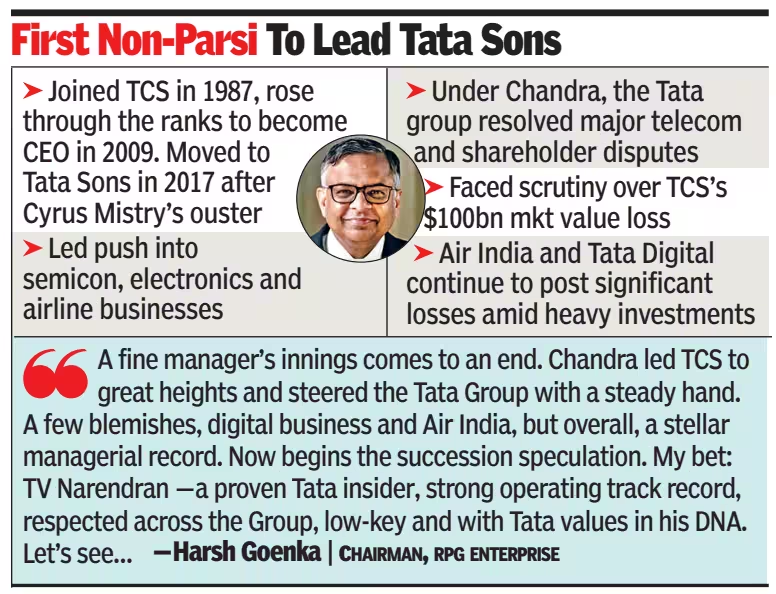
MUMBAI: Less than a week before Tata Sons’ Aug 18 AGM, the penny dropped for N Chandrasekaran. His extension as chairman was uncertain. For the first time, Chandra lacked a powerful patron just as his largest wagers, Air India and Tata Digital, were bleeding cash and TCS had shed nearly $100 billion in market value in the upheaval unleashed by ChatGPT and the wider AI boom.Chandra’s rise was shaped by his mentors. Faquir Chand Kohli, the legendary founder of TCS, hired him in 1987; Kohli’s successor, S Ramadorai, took him on as executive assistant, COO and, in 2009, CEO.
Rise of Chandrasekaran
Born in 1963 to an agricultural family in the small village of Mohanur on the banks of Cauvery, Chandra pursued science instead of his father’s legal practice. After graduating in applied sciences from Coimbatore Institute of Technology, he earned his Master of Computer Applications from Regional Engineering College (REC), Tiruchirappalli. At TCS, he came into the limelight as global head of sales for scaling up the international development centres.Chandrasekaran, the first non-Parsi to head Tata Sons, was not a natural choice to succeed Ratan Tata. In 2012, after publicly stating that his half-brother Noel Tata lacked broader exposure and experience for a larger role, Ratan Tata named the young Cyrus Mistry, whose family held the largest chunk of shares in Tata Sons, as chairman. The bitter fallout and subsequent ouster of Mistry led to Chandrasekaran moving from TCS to Tata Sons.Chandra’s first term at Tata Sons was underpinned by Ratan Tata’s authority, from Tata Motors’ labour talks to his reappointment. Their relationship grew into friendship, and Ratan Tata’s enthusiasm for aviation helped drive the Air India acquisition.Notwithstanding the challenges at TCS, Air India and Tata Digital, the group saw many successes under Chandra. Since FY17, Tata group revenue grew 2.4x to Rs 16.2 lakh crore, profit increased sixfold to Rs 1.7 lakh crore, while leverage fell from 16x to 0.9x and market capitalisation more than tripled to Rs 27 lakh crore. At Tata Sons, profit after tax rose 39x to Rs 32,000 crore.The group also built new businesses in electronics and India’s first and only semiconductor fabrication plant. Tata Steel added more capacity in a decade than it had since 1907. The auto components business rose from 18th to second place, retail expanded from 1,800 to more than 7,500 stores, and Tata AIA also climbed from 17th to second rank among life insurers.Ratan Tata’s death in Oct 2024 changed the power balance. Noel Tata’s appointment, followed by Mehli Mistry’s removal from Tata Trusts in Oct 2025, consolidated his influence. Chandra then faced scrutiny over TCS’s nearly $100 billion market-value loss, mounting losses at Air India and Tata Neu, and his strategy of accepting short-term pain to build future businesses. Tensions also grew over Tata Sons’ RBI upper-layer NBFC status, which could force a listing and expose the company to acquisition risk.Chandra’s decade at Tata Sons now reaches its finish line, marked by growth, costly bets and changing dynamics of power.
Stay updated with the latest legal news, judgments, internships, and opportunities.
N Chandrasekaran,Tata Sons,Air India acquisition,Ratan Tata,Tata group revenue growth