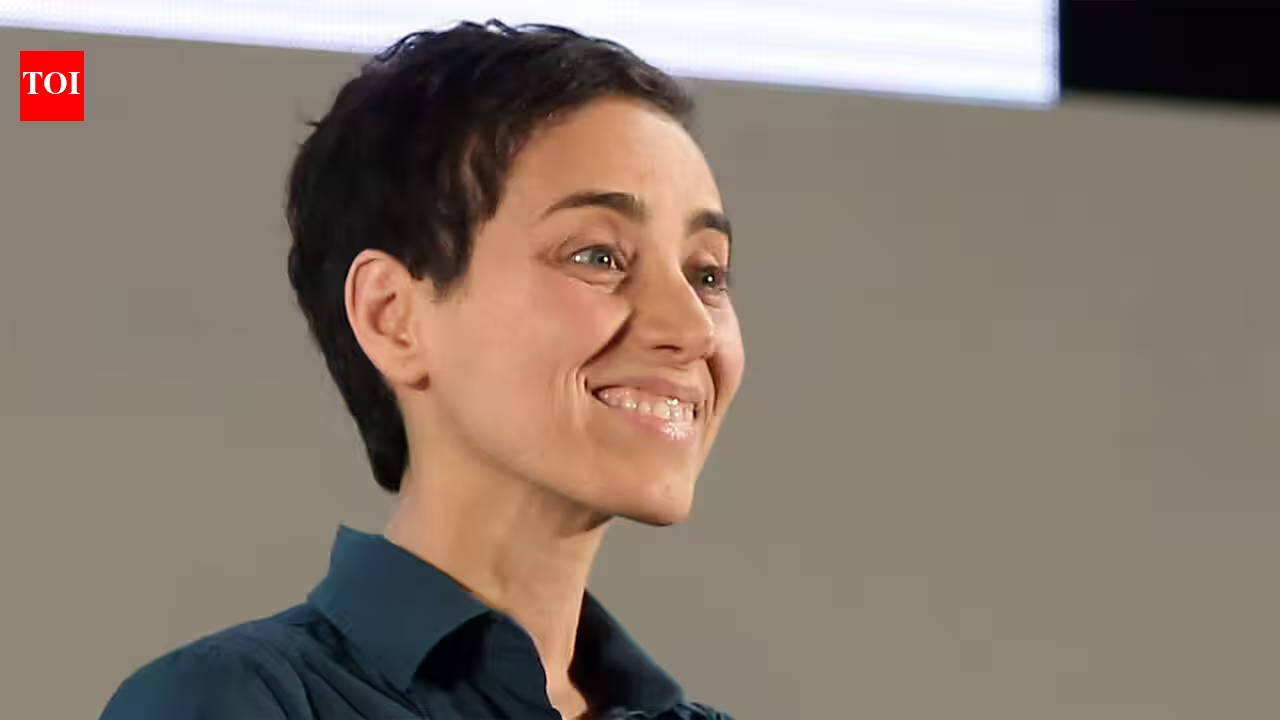
Legal News Update: 2026 TIME100 AI: Arvind Krishna, Anima Anandkumar, Vivek Raghavan among 9 Indian names shaping AI
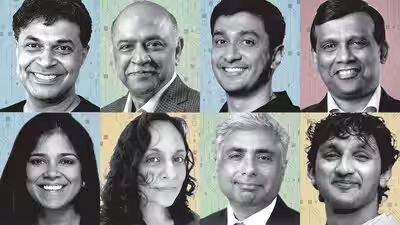
Artificial intelligence may be dominated by conversations around OpenAI, Google, Anthropic and Nvidia, but TIME’s 2026 list of the world’s 100 most influential people in AI tells a broader story. Among the people shaping the technology are nine Indian-origin figures working across enterprise technology, scientific research, healthcare, courts, public policy, AI safety and Indian-language systems.The TIME100 AI 2026 list is divided into four categories — Leaders, Innovators, Shapers and Thinkers — reflecting how influence in artificial intelligence now extends well beyond those building frontier models.Here are the nine names to know.Arvind Krishna: The IIT Kanpur graduate and IBM chairman and CEO has taken a different approach to the AI race, emphasising smaller and specialised models designed for enterprise applications. Krishna, who joined IBM in 1990 and became CEO in 2020, has argued that AI’s economic value will not necessarily come only from the biggest models.Ravi Kumar S: The Cognizant CEO has been recognised by TIME for his influence on enterprise AI and the future of work. A former nuclear scientist, Kumar argues that AI will change the tasks people perform rather than simply eliminate entire professions. Cognizant confirmed his TIME100 AI 2026 recognition for the second consecutive year.Vivek Raghavan: Raghavan helped build Aadhaar’s technology infrastructure before turning his attention to AI. As co-founder of Sarvam AI, he is working on models designed for India’s linguistic diversity and has argued for greater technological self-reliance in AI.Anima Anandkumar: The IIT Madras graduate and Caltech professor works at the intersection of AI and science. Anandkumar’s research has helped develop AI methods for physical modelling, including high-resolution weather forecasting, while her newer venture Accelerated Understanding focuses on using AI to model and understand the physical world.Utkarsh Saxena: A former Supreme Court law clerk, Saxena co-founded Adalat AI to use artificial intelligence in India’s judicial system. The company says its technology has reached more than 6,000 judges across 11 states. Andhra Pradesh has also announced statewide adoption of its system across the district judiciary from October 2026.Suchi Saria: Saria, founder of Bayesian Health and a Johns Hopkins professor, has developed AI technology designed to identify patients at risk of sepsis. The system received FDA clearance in May 2026, while Johns Hopkins reported that studies associated its use with a nearly 20% reduction in deaths.Meetali Jain: Jain represents the legal accountability side of AI. As founder of Tech Justice Law, she works on cases and advocacy involving alleged harms linked to AI systems and chatbots. Her work highlights an emerging question: how should technology companies be held accountable when AI systems allegedly cause real-world harm?Arvind Raman: Raman works on AI standards and evaluation in the US. His role at NIST and the Center for AI Standards and Innovation places him among those working to understand how advanced AI systems should be tested, assessed and evaluated for risks.Sunny Gandhi: Gandhi, co-executive director of Encode, represents the advocacy and policy side of the AI debate. His work focuses on stronger AI safety requirements, transparency and human oversight, particularly as artificial intelligence moves into sensitive areas.Why these nine matterTaken together, these profiles show how dramatically the AI landscape has expanded.There are technology CEOs deciding how businesses will use AI. There are researchers applying it to science and medicine. There are entrepreneurs putting it inside courtrooms. There are lawyers questioning AI companies over alleged harms. And there are policy advocates and standards experts asking how powerful systems should be governed.For Indian students and young professionals, that diversity may be the biggest lesson.AI is no longer a single career path. It is becoming an ecosystem that needs engineers, researchers, doctors, lawyers, policy experts, entrepreneurs and educators.The nine Indian-origin names on TIME100 AI 2026 reflect that change. Their work ranges from the infrastructure of Aadhaar to Indian-language AI, from sepsis detection to judicial transcription and from enterprise automation to AI safety.The message is clear: the future of artificial intelligence will not be shaped only by the people who build the models. It will also be shaped by those who decide where AI should be used, how it should be tested and what responsibilities should accompany its growing power.Disclaimer: This article is based on publicly available information and statements from the individuals and organisations cited. TOI Education has not independently verified all claims, figures or technical performance mentioned in the article.
Stay updated with the latest legal news, judgments, internships, and opportunities.
TIME100 AI 2026,Indian-origin AI leaders,Indian AI experts,Arvind Krishna,Anima Anandkumar,Vivek Raghavan