Legal News Update: Rs 20,700 crore, 326 km more: India completes its Dedicated Freight Corridor network as PM Modi inaugurates three new sections; now fully operational across 2,843 km with 443 trains daily as of now
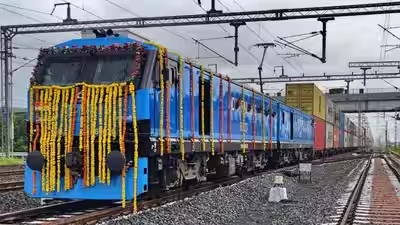
India’s dedicated freight corridors network is expanding with Prime Minister Narendra Modi inaugurating some key new sections on Tuesday. PM Modi dedicated three key sections of the Western Dedicated Freight Corridor (WDFC) to the nation. Together, these stretches cover 326 route kilometres and have been developed at a cost of more than Rs 20,700 crore. The sections are New Sanand (N)-New Makarpura, New Umbergaon-New Saphale and New Saphale-New JNPT.The Ministry of Railways undertook the construction of two Dedicated Freight Corridors. The Eastern Dedicated Freight Corridor (EDFC) runs from Ludhiana to Sonnagar and covers 1,337 km, while the Western Dedicated Freight Corridor (WDFC) connects Dadri with Jawaharlal Nehru Port Terminal (JNPT) over 1,506 km.
Dedicated Freight Corridor Network Complete
The direct link to the Jawaharlal Nehru Port Authority (JNPA) is expected to speed up the movement of EXIM cargo, improve connectivity between industrial hubs and ports, bring down logistics costs and ease congestion on Mumbai’s railway network.With these sections commissioned, the entire Dedicated Freight Corridor (DFC) network has become operational across its full length. The dedicated freight infrastructure is also expected to strengthen India’s logistics network by improving multimodal connectivity, cutting transit times and allowing cargo to move more seamlessly between different regions.PM Modi also flagged off freight train services from New Sanand (North), New Makarpura, New Umbergaon and New JNPT in Mumbai.
Dedicated Freight Corridors
Till the commissioning, it was reported that the two corridors together handle an average of around 443 trains every day. Their operational performance has remained strong, with freight volumes rising steadily alongside higher average speeds, quicker turnaround times and improved reliability, according to the Ministry of Railways.
| Year | Freight loading (in Million Tonnes) |
| 2014-15 | 1098 |
| 2015-16 | 1104 |
| 2016-17 | 1109 |
| 2017-18 | 1162 |
| 2018-19 | 1223 |
| 2019-20 | 1210 |
| 2020-21 | 1233 |
| 2021-22 | 1418 |
| 2022-23 | 1512 |
| 2023-24 | 1591 |
| 2024-25 | 1617 |
| 2025-26 | 1670 |
The DFC network has also freed up additional capacity on the conventional railway network by shifting freight traffic to the EDFC and WDFC. This has allowed the Railways to operate more goods and coaching services across its network.According to Indian Railways, the Dedicated Freight Corridor project is having a positive impact on transportation and logistics. This is due to greater movement of Double Stack Container (DSC) trains and higher axle load trains. DFCs also provide faster access from the northern hinterland to Western portsUnion Budget 2026 announced a new Dedicated Freight Corridor linking Dankuni in the east with Surat in the west. The work on preparing or updating the Detailed Project Report for the proposed corridor has already started.The Ministry of Railways said that these initiatives have contributed to an increase in freight loading and revenue for the national transporter over the past few years.Indian Railways’ freight loading rose to 1,670 MT in 2025-26, making it the second-largest freight-carrying railway system in the world.Indian Railways has also adopted a multi-pronged approach to strengthen freight logistics, improve regional connectivity and raise the Railways’ share in freight transportation. The strategy focuses on making freight operations more efficient, improving connectivity between regions and creating stronger first-and-last-mile logistics solutions.Some of the major initiatives include:Terminal Development: Indian Railways is taking a two-pronged approach to improve freight handling at terminals. This includes promoting modern rail freight terminals under the Gati Shakti Multi-Modal Cargo Terminal (GCT) policy, while also upgrading and expanding infrastructure at goods sheds owned by the Railways.Wagon Investment Schemes: Indian Railways has introduced several schemes to facilitate private sector investment in wagons. These include specialised wagons designed for particular commodities such as cement, oil, steel and fly-ash.Joint Parcel Product-Rapid Cargo Service (JPP-RCS) scheme: The JPP-RCS scheme is designed to provide customised logistics solutions based on the specific requirements of customers, including door-to-door parcel services.It also provides for online booking of parcel space through aggregators, in addition to India Post, using the ‘Virtual Aggregation Platform (VAP)’.CONCOR: CONCOR, a PSU under the Ministry of Railways, is using the JPP-RCS to provide door-to-door parcel services on the Delhi-Kolkata and Mumbai-Kolkata sectors.CONCOR is also operating a pilot project at Sonik Goods Shed to provide door-to-door logistics services.
Stay updated with the latest legal news, judgments, internships, and opportunities.
Dedicated Freight Corridor,Western Dedicated Freight Corridor,Eastern Dedicated Freight Corridor,logistics network India,Indian Railways freight loading