
Legal News Update: US seeks a cheaper alternative to MQ-9 as India seeks these drones for USD 3 billion
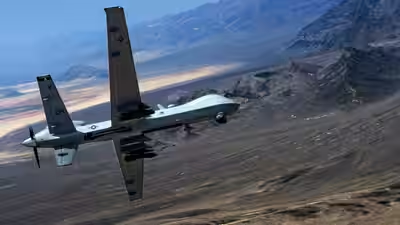
The US Air Force wants a cheaper and faster replacement for its dwindling fleet of MQ-9A Reapers. The force is seeking a unit price of around USD 10 million for the Unmanned Aerial Vehicle (UAV), which is considerably less than the USD 30-50 million dollars for a fully equipped aircraft. The urgency to bring in the new aircraft is caused by the loss of many of these aircraft in the ongoing operations in Iran as well as over Yemen.The new drone programme, called the Massed Modular Aircraft (MMA), is expected to retain the MQ-9A’s ISR and strike capability according to Air Force Lieutenant General Christopher Niemi, the service’s Chief Modernization Officer. Programme requirements call for a speed of at least 200 knots, a payload capacity of 2,800 pounds, an unrefuelled combat radius of 2,300 nautical miles (4,200 km), a ferry range of up to 8,000 nautical miles (14,000 km) and the ability to operate from runways as short as 6,000 feet. The MMA is expected to be built around a modular, open-architecture design that makes future upgrades easier.General Atomics, the original maker of the Reaper, has already responded with its Wildfire drone, pitched as delivering everything that made the Reaper effective, only sooner and at a fraction of the cost. With combat losses mounting and the Pentagon keen to field something more expendable and affordable at scale, the MMA programme looks set to reshape how America’s next generation of drones gets built.The US military has lost at least 45 MQ-9 Reaper drones during its ongoing conflict with Iran, close to a quarter of the roughly 185-strong fleet it started with, split between 165 with the Air Force and 20 with the Marine Corps. Operating heavily around the Strait of Hormuz, the drones have proven easy targets for Iran and its regional proxies given their slow speed and low-altitude profile, with some losses also traced to communication link failures rather than enemy fire.For nearly two decades, the Reaper has been the quiet workhorse of America’s Central Command operations, flying surveillance and strike missions across Iraq, Afghanistan, Yemen and Syria in largely uncontested skies. That flight profile, slow and predictable, worked brilliantly against terror organisations without an effective air defence capability. Against Iran, the same characteristics have turned into a liability, making it a comparatively easy kill.India, too, is buying into this same platform across all three services, eight each for the Army and Air Force and 15 for the Navy, in a deal worth over USD 3 billion, drawn largely by its 40-hour endurance and the surveillance picture that offers over the Indian Ocean and along India’s land borders. Induction is expected by 2029, with 21 of the drones to be assembled domestically and 34 per cent local component sourcing. The Navy, which already leases two Reapers, has just signed a fresh Rs 1,943 crore deal to extend that lease by 30 months, underlining just how central this aircraft has become to India’s own surveillance plans, contested skies notwithstanding.
Stay updated with the latest legal news, judgments, internships, and opportunities.
MQ-9 Reaper,Massed Modular Aircraft,US Air Force drones,affordable UAV,drone surveillance,General Atomics Wildfire,drones for India,US Air Force,India navy drones