
Legal News Update: ‘Earning billions’: How fuel exporters in India, US are benefitting from war-led oil supply disruptions

With global fuel supplies disrupted due to the Middle East crisis and Russia-Ukraine war, refiners in India and the US have emerged as beneficiaries. Oil refiners in the two countries are benefitting significantly as the conflicts have led to increased exports of refined fuel.Importers have been competing for available barrels during the peak summer driving season in the Northern Hemisphere.Worldwide refinery throughput declined to around 89 million barrels per day in July, according to International Energy Agency data, down by 5 million bpd from a year earlier. Global oil demand, meanwhile, remains above 100 million bpd, IEA figures show.
How India & US are reaping a bonanza
With their own operations unaffected by attacks or shipping restrictions, refineries in India and the US have increased exports to markets that previously depended heavily on supplies from the Middle East and Russia, according to a Reuters report.Also Read | How long can the world & India absorb the US-Iran war oil shock?Analysts and traders quoted in the report said refiners in both countries are likely to continue earning billions of dollars from stronger exports for as long as the conflicts keep traditional supply routes disrupted.
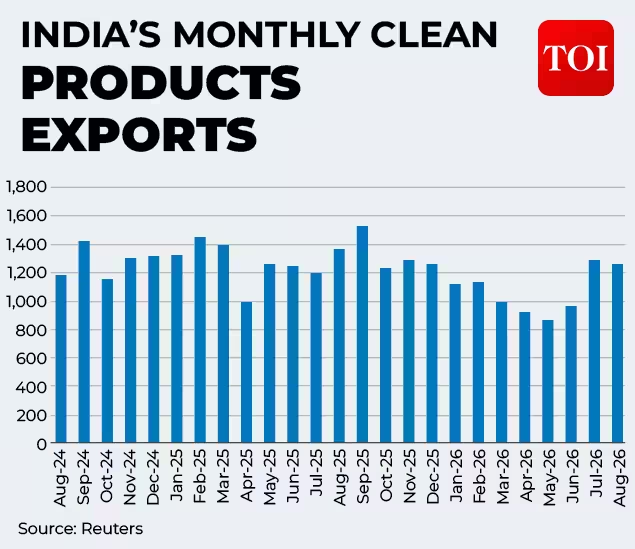
India’s monthly clean products exports
“India will continue to act as Asia’s swing supplier when regional markets tighten,” said Lin Ye, a vice president at consultancy Rystad Energy.Ye said India’s ability to respond to tighter regional supply-demand balances has been supported by consistently high operating rates at export-oriented refineries such as Reliance and Nayara.US refiners have also stepped up overseas sales. Government data showed that exports of distillate fuels, including diesel and heating oil, reached a record 1.9 million barrels per day in the week ended August 7. Jet fuel exports stood at 443,000 bpd, just below the record 455,000 bpd recorded in May.Also Read | Beijing’s billion-barrel weapon: Why India must prepare for China-driven oil prices
Stable demand drives exports
Demand from Indonesia, the largest gasoline buyer in Asia, has remained strong, the Reuters report said. A Singapore-based trader said the country is expected to consume around 11-12 million barrels in August, compared with 9-10 million barrels in July.Indonesia generally imports 88- to 92-octane gasoline, with India, Singapore and South Korea among its main sources. Rystad expects Indonesian demand to average about 636,000 bpd in the third quarter and 641,000 bpd in the fourth quarter, compared with an average of 631,000 bpd for 2025.Wood Mackenzie estimates that Indonesia’s fuel consumption could be higher this year at around 690,000 bpd, as the country’s heavily subsidised fuel market was less affected by the surge in crude prices.Kpler data showed that US fuel exporters have so far concentrated on European markets that previously imported significant volumes of Middle Eastern oil, as well as Latin American and other markets that had earlier depended on Russian crude.Brazil, one of the major importers of Russian diesel, sharply increased its purchases of US diesel last month. Kpler data showed that imports reached 196,000 bpd, more than twice the June level, after Moscow extended its ban on fuel exports through January 2027.Also Read | 100% tariffs: Why India may ignore Trump threat and continue buying Russian crude oil
Stiff competition from China
However, the report noted that Indian and US refiners could face their strongest competition from China, which has traditionally been the dominant fuel exporter to Asian markets.“Other exporters such as South Korea offer limited additional volume growth as uncertainty over crude supply is weighing on refinery runs,” Wood Mackenzie said according to Reuters.China began easing restrictions on fuel exports in July. LSEG Research said in a note that exports surged to 1.1 million tonnes, or 9,295,000 barrels, from 240,860 tonnes in June.Not only that, fuel demand in both the US and India is also limiting the amount refiners can send overseas, as the two countries are currently in their peak periods for gasoline and transportation fuel consumption.US gasoline demand averaged nearly 9 million bpd last week, broadly unchanged from the same period a year earlier, according to government data. Jet fuel demand was around 2 million bpd, significantly above the 1.6 million bpd recorded at the same time last year.India, meanwhile, is expected to remain an important source of growth in global fuel demand in the years ahead. Consumption is projected to continue increasing over the coming decade, meaning a larger share of the country’s refined fuel output is likely to be absorbed by domestic demand.
Stay updated with the latest legal news, judgments, internships, and opportunities.
India fuel exports,US oil refiners,Middle East oil crisis,global fuel demand,China fuel exports