Legal News Update: How Trump bypassed Iran’s negotiators and used Kurdistan’s Barzani to contact IRGC
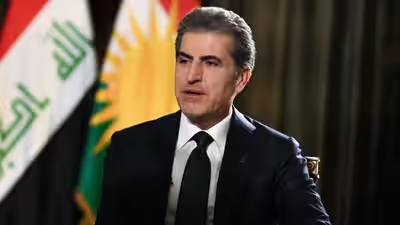
The Donald Trump administration took an unusual route in its efforts to end the war with Iran, turning to Iraq’s Kurdistan President Nechirvan Barzani as a backchannel to the powerful and raging Islamic Revolutionary Guard Corps (IRGC) after long-running Supreme Leader Ayatollah Ali Khamenei’s death in American-Israeli strikes, according to an Axios report.The move allowed Washington to bypass Iran’s official negotiators, including parliamentary speaker Mohammad Bagher Ghalibaf and foreign minister Abbas Araghchi, amid growing doubts over whether they had the authority to speak for the IRGC.The concerns emerged in mid-May, as US negotiators trying to reach a deal with Tehran began questioning whether Iran’s negotiating team was actually in a position to make commitments to the powerful military force, which had gained greater influence over the country’s national security and foreign policy decisions.With Washington unable to establish whether the official negotiators had the IRGC’s backing, the Trump administration turned to Barzani, an unlikely but trusted intermediary with links to both sides.Barzani had something few other potential mediators could claim, the trust of both US and Iranian leaders, according to the Axios report. His long-standing links with Tehran, fluency in Farsi and relationships with senior Iranian officials made him a natural choice for the sensitive backchannel.The episode, detailed by three sources with direct knowledge and reported by Axios, highlights a central challenge facing Washington: figuring out who actually holds the power to make decisions in Tehran.The US and Iran eventually reached a memorandum of understanding, but the understanding quickly collapsed. Any future negotiations could face the same problem, ensuring that Washington is talking to the people who are actually calling the shots.
How the backchannel began
After an April 8 ceasefire and a summit in Islamabad days later, US and Iranian officials resumed efforts to negotiate an end to the war.By early May, the White House believed it was close to a deal. But Iran delayed its response for more than 10 days, prompting US negotiators to question whether parliament speaker Mohammad Bagher Ghalibaf and foreign minister Abbas Araghchi had enough authority to finalise an agreement.White House officials began to suspect that the two negotiators were being overruled by the IRGC.Around May 10, then-director of national intelligence Tulsi Gabbard called Barzani, asking whether he could help establish contact with IRGC commander Gen Ahmad Vahidi.During the Iran-Iraq war, Barzani lived in Iran and studied at the University of Tehran. He speaks fluent Farsi and has personal relationships with senior members of the Iranian regime, including figures within the IRGC, according to sources cited by Axios.“Nechirvan Barzani is a pragmatic problem solver. He’s respected across the region. He knows nearly everyone in Tehran as well as Washington. That’s who you call in a pinch,” Brett McGurk, who has served as a Middle East adviser to four presidents, said in an interview.According to a source, Gabbard told Barzani that she was making the call with the approval of President Donald Trump and Vice President Vance.She wanted to know whether Vahidi and the IRGC leadership supported what Ghalibaf and Araghchi were negotiating or had different demands. Gabbard also noted that the mediators had been unable to reach Vahidi directly.
The secret call with the IRGC
Barzani agreed to help and contacted his links within the IRGC, telling them he had a message from the Trump administration.“But I want to talk directly to Gen. Vahidi,” Barzani stressed, according to one of the sources.The Iranians agreed. On May 14, an IRGC official arrived at Barzani’s office in Erbil, the capital of Iraqi Kurdistan, carrying an encrypted phone for a secure call.Barzani asked Vahidi whether he was aligned with Iran’s official negotiators.The Iranian general said he was.“I fully support them and this is also the position of the IRGC. We prefer to solve this crisis through negotiations,” Vahidi said, according to a source with direct knowledge.Three sources, including a White House official, told Axios that Barzani called Gabbard immediately after speaking with Vahidi and briefed her on the Iranian response. Gabbard then passed the information to the White House.
US sought secret talks in Erbil
After receiving the IRGC’s response, the Trump administration made another proposal: It wanted Barzani to host secret talks between senior US and Iranian negotiators in Erbil, according to a source familiar with the backchannel.Barzani conveyed the proposal to the Iranian side. Tehran did not rule it out but raised concerns about the security of its officials.Iranian officials feared that Israeli intelligence had extensive assets in Iraqi Kurdistan and could attempt to assassinate them in Erbil or during their journey to and from the city.The proposed Erbil meeting never took place.
What happens next?
According to regional sources cited by Axios, Pakistani and Qatari mediators continue to exchange messages between Washington and Tehran, but there has been little meaningful progress.Some sources believe Pakistan is giving more optimistic assessments of the talks than the situation warrants, in an attempt to create momentum and break the deadlock.Barzani, meanwhile, has recently sent messages to the White House offering to help revive US-Iran negotiations, according to a source familiar with the matter.
Stay updated with the latest legal news, judgments, internships, and opportunities.
Donald Trump administration,Islamic Revolutionary Guard Corps,Iran negotiations,Middle East diplomacy,US Iran backchannel talks,Nechirvan Barzani,Tulsi Gabbard,Erbil negotiations